Our position: AI is the companion, not the replacement
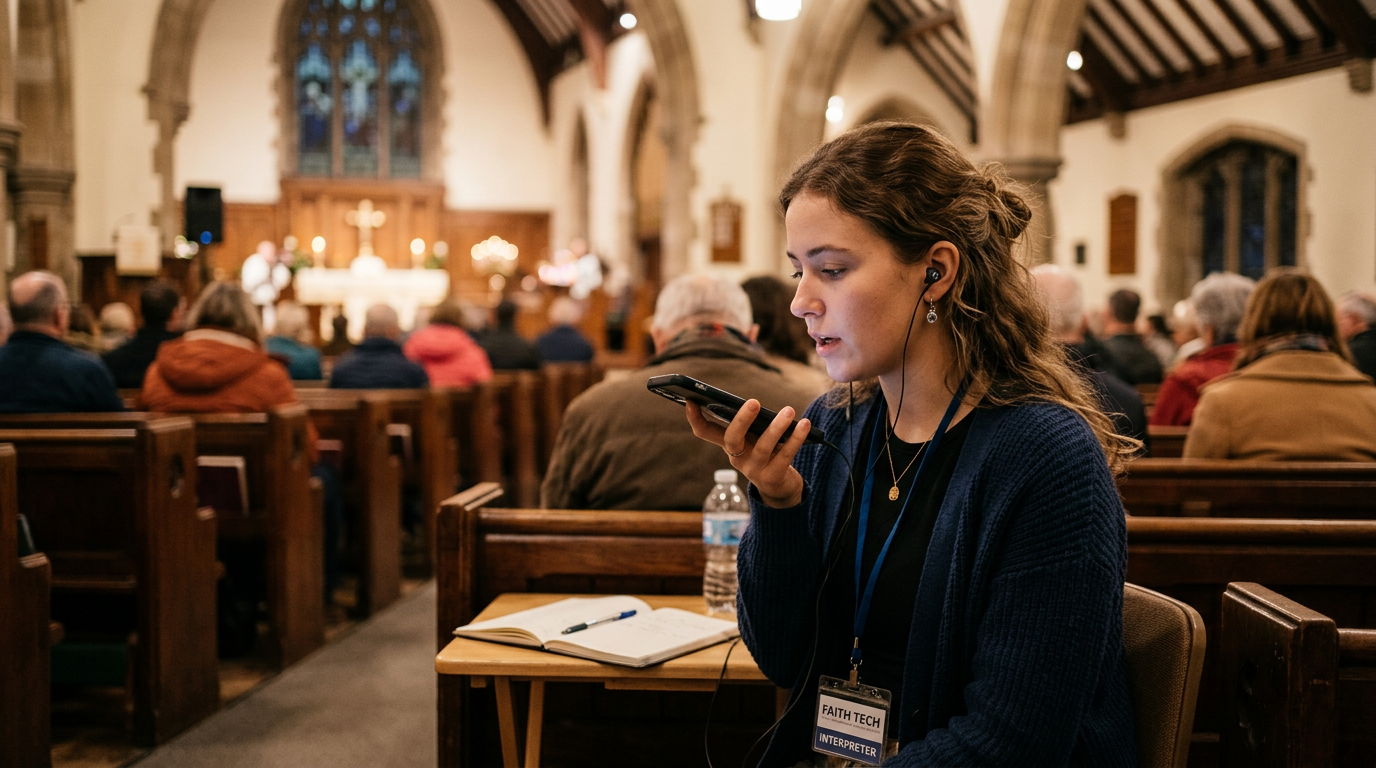
Volunteer interpreters are part of the ministry of your church. They build relationships, they carry cultural understanding, they bring pastoral care to the act of translation. We never position Church Translation Live as a way to make your interpreters redundant. We position it as a way to extend what they can do.
What human interpreters do best
-
✦
Cultural nuance and registerA human interpreter instinctively understands whether a passage calls for formal or informal language, and adjusts for their community's specific cultural context.
-
✦
Pastoral relationshipThe interpreter knows the congregation personally. They can choose to render a particular illustration in a way that resonates specifically with that community.
-
✦
Spoken delivery and toneA gifted interpreter can match the speaker's emotional register — rising with exhortation, softening with comfort — in a way AI voice synthesis cannot yet fully replicate.
Where AI extends their reach
-
↗
Languages without an interpreterMost churches can find a Spanish interpreter. Finding Amharic, Tigrinya, or Farsi is much harder. AI covers every language simultaneously.
-
↗
Backup when interpreters are unavailableInterpreters get ill, go on holiday, or step away during a service. AI fallback means the translation never stops.
-
↗
Written text alongside spoken interpretationEven when a human interpreter is speaking, deaf and hard-of-hearing members can read the AI text translation simultaneously.
-
↗
Unlimited concurrent listenersAn interpreter's voice reaches the headsets in the room. AI translation reaches anyone with a phone — in overflow rooms, at home via relay, or abroad.
The hybrid model: how Church Translation Live and interpreters work together
Church Translation Live includes a human interpreter channel. Here's how it works in practice:
1
Your interpreter joins via a secure link
No app, no specialist device — just a phone with a browser. They hear the original audio in one earbud and speak their translation into the phone.
2
Their voice is relayed live to all listeners on that language channel
Listeners on that language channel hear the interpreter — not AI — and see a "Live interpreter" badge. The AI text continues in parallel for deaf and hard-of-hearing members.
3
If the interpreter steps away, AI takes over seamlessly
Automatic fallback — no gap in service. When the interpreter returns, they resume with one tap. Listeners never know there was a switch.
A note on interpreter wellbeing
Volunteer interpreters often carry significant pressure — serving for an entire service without a break, knowing that a whole language community depends on them. The AI fallback reduces that pressure. Interpreters can take breaks, step out briefly, or rest without letting their community down. In practice, our users find that interpreters are more willing to serve sustainably when they know the AI has their back.